Every great skater, no matter how advanced, lives inside one simple position: the basic
skating stance. Teaching this stance clearly at the start prevents many falls and gives
children a “home base” they can always return to.
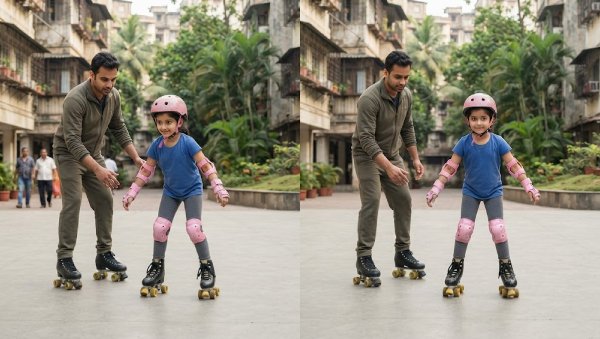
Step 1: Foot position Ask the child to stand with feet about shoulder-width apart. Toes should point slightly outwards in a soft “V” shape, not straight ahead or turned inward.
Step 2: Knees bent Ask them to imagine sitting on a high stool. Knees are bent and soft—never locked. If you gently push their shoulders, they should absorb the push with their legs, not topple over
Step 3: Hips and torso Hips should be slightly back, as if they are about to sit, while the chest stays up. The torso tilts just a little forward so that the skater’s center of gravity stays over the middle of the feet, not behind the heels.
Step 4: Arms for balance Arms should be slightly bent and raised in front or to the sides like airplane wings, not hanging at the sides or flailing behind. This gives instant balance and readiness.
Step 5: Eyes up Children naturally want to look at their feet. Teach them instead to look a few meters ahead. This keeps their posture aligned and allows them to anticipate obstacles.
Once this stance feels comfortable, all early drills—marching, tiny pushes, first
glides—come from and return to this position. The message is simple: when in doubt, go
back to stance.
The minutes after a race are crucial. Children are emotionally open and sensitive; the way adults respond can either deepen their love for sport or... Continue reading
To a child, “district” or “state” sounds big and intimidating. Demystifying the process reduces anxiety and helps them walk in feeling prepared rather than overwhelmed.... Continue reading
At grassroots level, children usually see a mix of fun formats and formal races. Understanding the options helps parents and skaters choose events that match... Continue reading
A child is “ready” not just when they can skate fast, but when they are physically, technically, and emotionally prepared for a more structured challenge.... Continue reading

Add comment